

RPFT Exam Info and Free Practice Test Professional Quiz Study Materials
Accurate Hot Selling RPFT Exam Dumps 2025 Newly Released
NBRC RPFT (Registry Examination for Advanced Pulmonary Function Technologists) Certification Exam is a professional certification program designed for individuals who are interested in pursuing a career in the field of pulmonary function technology. Registry Examination for Advanced Pulmonary Function Technologists certification exam is administered by the National Board for Respiratory Care (NBRC) and is recognized by employers across the United States as a standard of excellence in this field.
NBRC RPFT exam is administered by the National Board for Respiratory Care (NBRC), which is an independent credentialing organization for respiratory therapists and pulmonary function technologists. The NBRC is recognized as the leading authority in respiratory care credentialing, and its exams are highly respected in the industry. To be eligible to take the RPFT exam, candidates must have a current CRT or RRT credential, and must have completed a minimum of 12 months of clinical experience in pulmonary function technology.
NEW QUESTION # 21
In setting up a CO analyzer, a pulmonary function technologist notices that the analyzer reads -0.03 while sampling air. The technologist should
- A. Accept the reading because it is within +- 3%.
- B. Adjust the reading to +0.03.
- C. Reverse the sample flow.
- D. Adjust the reading to 0.00.
Answer: D
NEW QUESTION # 22
The following values are reported at maximum effort for a 50-year-old, 70-kg (154-lb) male with significant coronary artery disease during ergometer stress testing. Which of the following is most likely an error?
- A. VE65L/min
- B. workload 200 watts
- C. RER1.2
- D. HR145/min
Answer: B
Explanation:
Explanation
NEW QUESTION # 23
During a cardiopulmonary stress test using breath-by-breath gas analysis, a pulmonary function technologist notices that the VO2 suddenly decreases. Which of the following may explain this change?
1. The patient has achieved anaerobic threshold.
2. The measurement of the expired gas volumes is inaccurate.
3. O2 analyzer "phase delay" has increased.
4. There is a leak in the tubing or mouthpiece.
- A. 1, 2, and 4 only
- B. 1, 2, and 3 only
- C. 1, 3, and 4 only
- D. 2, 3, and 4 only
Answer: C
NEW QUESTION # 24
Biological control data are obtained for lung volumes by plethysmography. The following results are obtained: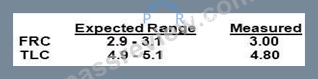
A pulmonary function technologist should repeat the test instructing the individual to
- A. Inhale to TLC
- B. Inhale to TV
- C. Pant at 40 to 50 Hz
- D. Pant at 90 to 100 Hz
Answer: A
NEW QUESTION # 25
The desiccant column on an infrared CO2analyzer is pink. The readings obtained from this analyzer would result in
- A. No effect on CO2
- B. An unstable reading
- C. Adecreased CO2
- D. An increased CO2
Answer: D
NEW QUESTION # 26
An arterial blood gas performed prior to exercise on a 45-year-old patient shows the following results: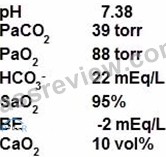
A pulmonary function technologist should conclude that the patient's
- A. Values are within normal limits.
- B. Dead space ventilation is above normal.
- C. Hemoglobin level is below normal.
- D. Alveolar ventilation is above normal.
Answer: C
NEW QUESTION # 27
A patient's vital capacity is slightly reduced, the FEWFVC is normal, and the uncorrected DLco is increased. Which of the following is the most likely diagnosis?
- A. diffuse pulmonary fibrosis
- B. polycythemia vera
- C. kyphoscoliosis
- D. diaphragmatic hemiparesis
Answer: B
NEW QUESTION # 28
A patient with severe airflow limitation pants too rapidly (> 3 breaths/second) against a closed shutter in a body plethysmograph. Which of the following will occur?
- A. VTG overestimation
- B. VTG underestimation
- C. RAW overestimation
- D. RAW underestimation
Answer: C
NEW QUESTION # 29
The following arterial blood gas results are obtained during the final workload of a cardiopulmonary exercise test: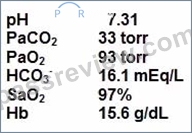
Which of the following best explains these results?
- A. IV solution has contaminated the blood sample.
- B. The test indicates a right-to-left shunt.
- C. There is air contamination since the PaCO2is so low.
- D. Blood gas results are normal for someone at end-exercise.
Answer: D
NEW QUESTION # 30
A pulmonary function technologist is performing an exercise (stress) test on a patient with severe COPD. As the test progresses, the patient shows signs of increasing dyspnea. Measurements of inspiratory capacity decreased from 2.0 L to 1.5
L. Which of the following most likely occurred?
- A. disconnected gas sampling line
- B. acute decrease in FRC
- C. dynamic hyperinflation
- D. drift in the flow transducer
Answer: B
NEW QUESTION # 31
CORRECT TEXT
A pulmonary function technologist is reviewing results of a recent mechanical diffusion simulation using a 3-liter syringe. The test was conducted at a room temperature of 22 C.
The following BTPS results were reported:
Which of the following should the technologist do?
- A. Recalibrate the gas analyzer.
- B. Change the calibration gases.
- C. Proceed with testing.
- D. Recalibrate the pneumotachometer.
Answer: C
NEW QUESTION # 32
Biological control data are obtained for lung volumes by plethysmography. The following results are obtained: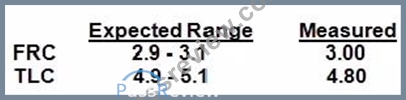
A pulmonary function technologist should repeat the test instructing the individual to
- A. Inhale to TLC
- B. Inhale to TV
- C. Pant at 40 to 50 Hz
- D. Pant at 90 to 100 Hz
Answer: A
NEW QUESTION # 33
Which of the following is an appropriate reason to perform a multiple-breath nitrogen washout test?
- A. Measure anatomical dead space.
- B. Differentiate obstruction from restriction.
- C. Measure oxygen consumption.
- D. Detect early small airway disease.
Answer: D
NEW QUESTION # 34
Which of the following is the most reliable indicator that a patient has achieved his maximum exercise capacity during a progressive exercise (stress) test?
- A. Heart rate of 210/min
- B. Minute ventilation greater than 170 L/min
- C. Respiratory exchange ratio greater than 0.8
- D. VO2remains stable with increasing workload
Answer: D
NEW QUESTION # 35
An isothermal lung analog has the following specifications:
5-L glass bottle 2000 g of steel wool Density of steel wool 5 g/cm3
Volume of connectors and bulb 100 mi-Repeated FRC measurements in the plethysmograph result in a volume of 5.5 L.
Which of the following should a pulmonary function technologist do?
- A. Recalculate the BTPS correction
- B. Remove 500 g ofsteel wool from the lung analog
- C. Begin a biologic control program
- D. Take the plethysmograph out of service
Answer: C
NEW QUESTION # 36
A comparison of two techniques for measuring Rawis shown below: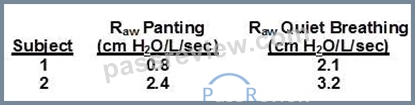
Which of the following should a pulmonary function technologist conclude?
- A. Subject 1 panted too forcefully.
- B. Subjects 1 and 2 both have reactive airways.
- C. Results are consistent with the two methodologies.
- D. The system was calibrated for quiet breathing.
Answer: C
NEW QUESTION # 37
A pulmonary function technologist reviews the following home monitoring spirometry results: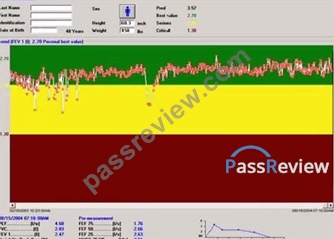
According to National Asthma Education and Prevention Program (NAEPP) guidelines, what feedback should the technologist give to the patient regarding test performance?
- A. Ask the patient to recalibrate the spirometer.
- B. Encourage the patient to continue testing and monitoring the FEW
- C. Come into the office for further instructions on proper testing technique.
- D. Ask the patient to blow out longer.
Answer: B
NEW QUESTION # 38
A treadmill belt stops for a fraction of a second each time the patient takes a step. A pulmonary function technologist should
- A. Increase the speed of the belt.
- B. Decrease the treadmill grade.
- C. Instruct the patient to use the hand rails.
- D. Tighten the belt.
Answer: D
NEW QUESTION # 39
Which of the following information reported from a recent methacholine challenge test best summarizes the patient's bronchial hyperresponsiveness?
- A. patient reported chest tightness and a cough
- B. PC20 = 2.3 mg/mL
- C. diluent FEV1 = 92% predicted
- D. postbronchodilator recovery FEV1 = 106% baseline
Answer: A
NEW QUESTION # 40
A patient is performing a flow-volume loop. A pulmonary function technologist observes equal decreases in expiratory and inspiratory flows resulting in plateaus. Patient effort is satisfactory, and he follows instructions well. The technologist should expect the patient to have a
- A. Fixed large airways obstruction.
- B. Variable large airways obstruction
- C. Small airways obstruction
- D. Restrictive disorder
Answer: D
NEW QUESTION # 41
The following values are reported at maximum effort for a 50-year-old, 70-kg (154-lb) male with significant coronary artery disease during ergometer stress testing. Which of the following is most likely an error?
- A. VE65L/min
- B. workload 200 watts
- C. RER1.2
- D. HR145/min
Answer: B
NEW QUESTION # 42
......
Get 100% Authentic NBRC RPFT Dumps with Correct Answers: https://vcetorrent.passreview.com/RPFT-exam-questions.html